Showing posts with label Rover Scouts. Show all posts

Sunday, 7 November 2021

Document of Australia Scouting


 Australia Scouting

Australia Scouts is a trading name of The Scout Association of Australia which is the largest Scouting organisation in Australia. It is a member organisation of the World Organization of the Scout Movement. It operates personal development programs for children and young adults from 5 to 25 years of age in Australia and Australian territories. It was formed in 1958 and incorporated in 1967. Scouts Australia's programs were opened to girls after 1971.[citation needed]

The current stated purpose of Scouts Australia is to "contribute to the development of young people in achieving their full physical, intellectual, emotional, social and spiritual potentials as individuals, as responsible citizens and as members of their local, national and international communities".

Despite opening participation to girls and ever younger children and Australia having a high population growth rate, well above the world average, participation in the organisation's programs declined in the late 20th and early 21st centuries. According to a 2014 media article, "Scouts Australia is hoping [to] arrest a steady decline in membership. In 1979 the organisation had 114,500 youth members, today there are 52,000." According to its own annual reports participation decreased from 84,502 in 2,126 groups in 2001 to 63,200 in 1,836 groups in 2005, and in 2012 there were 49,181 youth, 2,587 young adult Rovers and 14,113 adult leaders and support roles in 1,486 groups. This means the organisation has an exceptionally high number of adults compared to its number of youth participants with a ratio of more than one adult for every three youths.


Scouts Australia Program Resources

Structure 

Australia Scouts is a council consisting of a majority of members elected by the council itself, office bearers appointed by the council or its executive committee, state and territory office bearers appointed by the national executive committee and a smaller number of representatives from state and territory branch councils which are similarly not elected by or representative of the Scouts, the adults in Scouting or Scout groups. The national council usually meets just once a year. Its national executive committee seeks to achieve co-operation and coordination of the state and territory branches. The New South Wales, Victorian and Tasmanian state branches are incorporated under special Acts of the state parliaments. while the Western Australian, South Australian, Queensland, Northern Territory and Australian Capital Territory branches are incorporated by registration under the ordinary Associations Incorporation Acts. Each state or territory branch maintains its own structure and operational methodologies and rules. However, all branches operate programs for children and young adults under a common uniform and common award scheme structure.

The organisation's current Chief Scout is David Hurley, the Governor-General of Australia. The Chief Scout of each state branch had usually been the governor of the state. In 2015, the actor Shane Jacobson was appointed as the Chief Scout of the Victorian branch. In 1942, Sir Leslie Orme Wilson, the Governor of Queensland, resigned as the Boy Scouts Association's Chief Scout of Queensland because of the failure of the Queensland branch to respond to his call for reforms to its centralisation effort that led to the severance of the Mount Morgan Blue Boy Scouts.

New Logo and Identity for Scouts Australia by Cato Brand Partners

History
For the history of Boy Scouts and the Scout Movement in Australia generally, see Scouting and Guiding in Australia. The organisation was formed in 1958, under the name Australian Boy Scouts Association, as a branch of the Boy Scouts Association of the United Kingdom. Prior to its formation, branches of the Boy Scouts Association had been formed in each of the Australian states. Initially each Australian state branch was directly responsible to Imperial Headquarters of the Boy Scouts Association in London. In 1922, the Boy Scouts Association formed its Australian Federal Council, consisting of nominees of its Australian state branches, to achieve co-operation and co-ordination at a national level. The Boy Scouts Association later appointed an Australian commissioner. The Australian Federal Council functioned as a branch of the Boy Scouts Association of the United Kingdom and the Australian commissioner was appointed by the Imperial Headquarters in London. The Australian Federal Council of the Boy Scouts Association became a member of the International Conference of the Boy Scout Movement in 1953, rather than being represented through the Boy Scouts Association of the United Kingdom. In 1958, when the Australian Boy Scouts Association was formed, it succeeded the Australian Federal Council of the Boy Scouts Association.

Boy Scouts being reviewed in Canberra in 1927
 
 
In 1967, the organisation was incorporated by royal charter as a branch of the Scout Association of the United Kingdom. Each of the Australian state branches and the Papua New Guinea branch of the Scout Association became branches of the Australian Boy Scouts Association. In 1975, the organisation's Papua New Guinea branch became an independent organisation. in 1971, the organisation dropped the word "boy" from its name when it changed its name from the Australian Boy Scouts Association to the Scout Association of Australia. Until 1976, it admitted only British subjects to membership and programs and other nationalities only on special conditions and approval. After 1976, British subjects continued to be automatically admitted to membership while others, including residents, were still subject to special conditions and approval. In 1997, the organisation adopted the trading name Scouts Australia.
 
Program reviews
In 1969 the organisation began a review of its youth programs under its Design for Tomorrow Committee and implemented its New Design program from 1971. The program involved a new name, new branding, new uniforms and new award schemes. It failed to attract an increase in participants and led to considerable disaffection and loss of long-term leaders and supporters and the formation of Australian affiliates of the traditionalist Baden-Powell Scouts' 
Baden-Powell Scouts' Association
 
Association while its decline in participation continued. In 1997, the organisation adopted the new trading name Scouts Australia, new logo, uniforms and branding to be more appealing, but participation rates and numbers continued to decline. In 2001, the organisation formed its National Youth Council to engage youth in its national operations and provide opportunities for youth leadership at a national level. It is composed of 25 Scouts, Venturers and Rovers. The council meets face to face twice a year and online throughout the rest of the year. Despite this, youth participation rates and numbers continued to decline.

A further program review commenced in 2013. In 2019, a new program, along with new logo and branding, was launched, again hoping to appeal to a larger audience. Elements of this program include the catchphrases "youth leading, adults supporting", "plan, do, review", another overhaul of its award scheme and a return to a focus on outdoor adventure.
The Scouts Australia emblem from 1997 to 2019 incorporated the national green-and-gold as well as the Southern Cross motif

Religion
Scouts Australia is a non-religious organisation. To enrol with Scouts Australia you are required to make the Scout Promise. The unique wording in the Australian Scout Promise of “do my best to do my duty to my God" allows some flexibility and Scouts Australia is open to people of all religious faiths that can make this promise. In 2017, with the launch of "The Adventure Begins", a new promise option allows Scouts to "do my best to be true to my spiritual beliefs", to further open the promise to all religious faiths.

Historically, Scouting in Australia was rooted in Christianity as that was the world view of Scouts founder, Lord Baden-Powell. Although Britain is now a majority non-religious nation Christianity was the dominant faith in both Britain and Australia in Scouting's early days.

More recently, [clarification needed] participants have come from many faiths and although the majority of Scout groups promote an interfaith approach to religion. Many Scout groups have been formed within existing communities and specific religious traditions as "sponsored groups", such as Coptic Orthodox, Greek Orthodox, Islamic and Jewish.

Youth participants at a Scouts' Own, an informal act of worship, at a Scout campsite

Children & Youth Programs

Age sections
Youth development in the organisation's programs is divided into several age group stages. The age groups encourage movement through the sections as the youth matures. The sections are:

1. Joey Scouts (5–7 years): helping to develop a child's sense of personal identity
2. Cub Scouts (8–10 years): aims to develop a sense of adventure and achievement and a chance to grow their character
3. Scouts (11–14 years): promotes leadership and teamwork, as well as an appreciation of the outdoors
4. Venturer Scouts (15–17 years): develops leadership and management skills, as well as an understanding of camping and the environment
5. Rover Scouts (18–25 years): continues to develop leadership skills, as well as placing a strong emphasis on service to the community and other parts of the organisation

Uniform
The core uniform is a navy blue shirt with the relevant youth section colour across the sleeves and collar, a scarf and woggle. The leaders' shirt is only dark blue.

The section colours are:

1. Tan for Joeys
2. Yellow for Cubs
3. Green for Scouts
4. Maroon for Venturers
5. Red for Rovers

Award Scheme
The youth award scheme in Australian Scouting consists of awards for proficiency in an adventurous activity, participation in major events, recognition of service, gallantry and meritorious service, and for the practice of Scouting (Queen's Scout, Baden-Powell Award, etc.).

Queen's Scout

The highest award for each section is Promise Challenge, Grey Wolf Award, Australian Scout Medallion, Queen's Scout Award, and Baden-Powell Award respectively.

 Baden-Powell Award
 
 
Australian Scout Medallion

Grey Wolf Award 

Lone Scouts
The Lone Scout Group is for youth unable to attend or find a local Scout group. Lones include people with disabilities and are therefore unable to attend regular group meetings, people who are constant travellers or go to places at which they are unable to attend a group i.e. boarding school or isolated communities. They hold annual week-long camps for members and their families. Lone scouts have meetings over the radio.

Lone Scouts Australia

International connections
The organisation operates in the non-sovereign Australian Indian Ocean Territories of:

Christmas Island
Cocos (Keeling) Islands

Two Scout troops in Singapore are affiliated with the organisation. The organisation is a founder member of the Asia-Pacific Region of the World Organization of the Scout Movement. In the field of support and co-operation with other national member organisations of the Asia Pacific region, the organisation has contributed to a number of international friendship and community development oriented projects. Over the years, Australian Scouts have supported emerging Scout organisations in the South Pacific. A twinning project with the Bangladesh Scouts, known as the "Bangladesh-Australia Child Health" (BACH) project, made a dramatic impact on child health in project villages during its operation from 1986 to 1992. The organisation has a twinning project with the Nepal Scouts known as NATURE Project and involves the reforestation of the Kristi Landslide.

In 1988 the organisation hosted the 16th World Scout Jamboree and the 31st World Scout Conference. Some 15,000 Scouts from 94 countries attended the jamboree at Cataract Scout Park near Sydney. An Australian Scout Jamboree has been held every three years since 1934 except for the years of the Second World War. The Scout jamboree is the organisation's largest event but an Australian Rover Moot and an Australian Venture are also held every three years.

Wednesday, 22 April 2015

Pioneering For Scouting Activity

Documentary Resources of  World Scouting
World Organization of The Scout Movement
Pioneering For World Scouting Activity
Documentary of Pioneering For Scouting :-
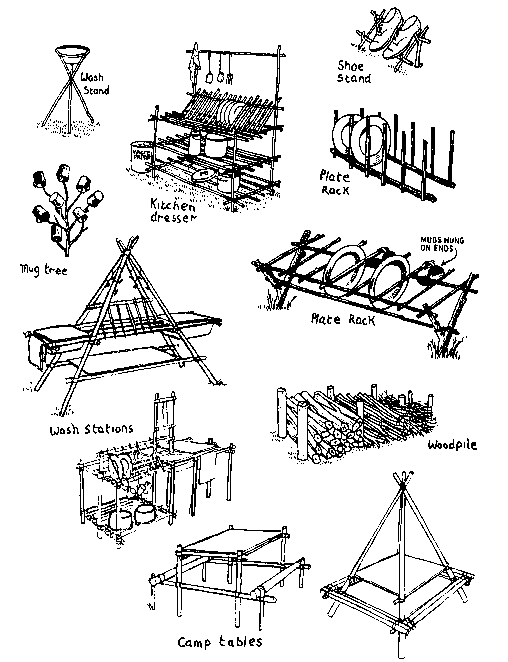
In the Scout Movement, pioneering is the art of using ropes and wooden spars joined by lashings and knots to create a structure. Pioneering can be used for constructing small items such as camp gadgets up to larger structures such as bridges and towers. These may be recreational, decorative, or functional. Pioneering is used to teach practical skills, teamwork and problem solving. It is widely used in Scouting and Girl Guiding. Many Scout and Guide groups train their members in pioneering skills and construct projects, both small and large. In camp, Scouts may construct functional items like tables, camp dressers and gadgets, as well as decorative camp gateways. Pioneering is a common merit badge in many countries, and was required for the Eagle Scout rank in the 1920s and 1930s. The name comes from the 18th and 19th century military engineers who went ahead of an army to "pioneer" a route, which could involve building bridges and towers with rope and timber (for example the Royal Pioneer Corps). Pioneering skills include knot tying (tying ropes together), lashing (tying spars together with rope), whipping (binding the end of a rope with thin twine), splicing (joining or binding the end of a rope using its own fibres), and skills related to the use, care and storage of ropes, spars and related pioneering equipment.
 
Pioneering For Scouting Projects
Basic Knots of Pioneering For Scouting :-
There are a number of basic knots used in pioneering : 
 
•    Bowline
Bowline

•    Clove hitch
Clove hitch
•    Reef knot
Reef knot
•    Sheet bend
Sheet bend
•    Timber hitch
 
Timber Hitch
There are also a number of specialized pioneering knots that are used to add safety and functionality to pioneering projects:
 
•    Butterfly Loop
Butterfly Loop
•    Carrick Bend
Carrick Bend
•    Rolling hitch
Rolling hitch
•    Roundturn and Two Half Hitches
Roundturn and Two Half Hitches
Basic lashings of Pioneering For Scouting :-
•    Square lashing, which gets its name from the fact the wraps are “square” to the poles. Square Lashings bind poles that are in contact and cross each other at
any angle from 45º to 90º
•    Diagonal lashing, used when securing two spars when they cross but do not touch as in the "X" of an H-frame trestle
•    Round lashing, used to join two poles in a straight line
•    Sheer lashing, (also spelled Shear Lashing) used to join two poles in a scissors shape, to be spread out, most often to form the legs of an A-frame.
 
Pioneering Structures :-
These basic structures are the building blocks for a number of pioneering projects:
•    A-Frame: The basis of many tower structures. The horizontal member of the A-frame also makes a convenient springing point for a deck such as a table-top.
•    Trestle: Used as a modular element for building bridges and towers. Also used as a 'chariot' for inter-Patrol chariot races. Often referred to as X-Trestle or H-Trestle
•    Tripod: As end supports for swingbridges, dining tables, etc. and as the basis for the hourglass tower. A tripod is not considered secure unless its legs connected with cross braces, or are staked or otherwise attached to the ground.
 
Pioneering Projects :-
•    Aerial runways
Aerial runways
•    Ballistae
Ballistae
•    Benches
Benches
•    Bridges
Bridges
•    Camp gadgets
Camp gadgets
•    Camp gateways
Camp gateways
•    Catapults
Catapults
•    Chairs
Chairs
•   Chippewa Kitchens
Chippewa Kitchens
•    Dressers
•    Ferris Wheel
•    Flagpoles
•    Merry-Go-Rounds
•    Rafts
•    See Saws
•    Swing Sets
•    Swinging Ships
•    Tables
•    Towers
•    Trebuchets

Tuesday, 31 March 2015

Documentary of World Scout Jamboree

Documentary Resources of  World Scouting
World Organization of The Scout Movement


Documentary of Scout Jamboree :-
The World Scout Jamboree is a Scouting jamboree of the World Organization of the Scout Movement, typically attended by several tens of thousands of Scouts from around the world, aged 14 to 17. In Scouting, a jamboree is a large gathering of Scouts who rally at a national or international level. The 1st World Scout Jamboree was held in 1920, and was hosted by the United Kingdom. It was for this jamboree that the founder of scouting, Lord Baden-Powell, wrote the song "ging gang goolie" because it could be sung by anyone. Since then, there have been twenty two World Scout Jamborees, hosted in various countries, generally every four years. There are also national and continental jamborees held around the world with varying frequency. Many of these events will invite and attract Scouts from overseas.
The World Scout Jamboree "Around the World"
History :-
While World Scout Jamboree is the expression used by the World Organization of the Scout Movement, other organizations held events called "jamborees" for their members. The Scouting program became an international success following its founding by Robert Baden-Powell in 1907. With its continuing growth, the founder of the movement saw a need for a gathering of representatives of Scouting from all around the world. The general aim was to foster a worldwide brotherhood, and to help the young Scouts in the movement learn about other peoples and nations by direct interaction with them. The idea of organizing such periodical international gatherings was originally conveyed to Baden-Powell by the General Chief of the Scouts of Greece, Konstantinos ("Kokos") Melas, during the 1918 international Scout meeting, in England. Captain Melas proposed the gatherings should repeat every four years, in the same way Olympic Games were held in Ancient Greece. The suggestion was accepted with enthusiasm by Baden-Powell, who named the gatherings "Jamborees". However, the outbreak of the First World War in 1914 delayed any plans for such an event. It was not until 1920 that the first World Scout Jamboree could be realized. It was held in the Olympia halls in Kensington, London. Symbolically, the Jamboree site bore the name of the birthplace of the Olympic Games, Olympia. 8,000 Scouts from 34 countries attended the event. Thereafter, a Jamboree has been held every four years. There are two exceptions to this: no Jamboree was held between 1937 and 1947 because of the Second World War, and the 1979 Jamboree, which was to be held in Iran, was cancelled due to the political upheaval in the region at that time. The Jamboree has been held in different countries around the world. The first seven Jamborees were held in Europe. The eighth World Jamboree was held in North America where the tradition of moving the Jamboree among the continents began. As yet, Africa has not hosted a jamboree. To replace the cancelled event of 1979, the World Scout Committee determined that an alternative celebration, the World Jamboree Year should take place. Several regional camps took place, such as the 12th Australian/4th Asia-Pacific Jamboree, held in Perth, Western Australia, along with countless Join-in-Jamboree activities — designed to allow Scouts from around the world to participate in an activity that thousands of other Scouts around the world were also participating in at the same time. This Join-in programme is being reproduced again as part of the Scouting 2007 Centenary celebrations. So far, the greatest attendance of all Jamborees was in 1929, where over 50,000 members from around the world descended upon Birkenhead in the north-west of England. This number represented the permanent contingent who remained for the entire event. They were joined by hundreds of thousands of visiting Scouts who participated on a day basis. The first Jamboree was more akin to an exhibition of Scouting, allowing visitors to see how things were done in other parts of the world. The Second Jamboree was conducted on a camp basis and each successive Jamboree has developed on this format where the programme is typically more activity oriented, with plenty of time for Scouts from different nations to interact and learn about each other in less formal ways than an exhibition would allow. The 2007 Jamboree coincided with the Scouting Centenary celebrations. Because of this, the honour of hosting the event was again bestowed upon the United Kingdom, as the birthplace of Scouting. Over 40,000 young people camped in August at Hylands Park in Chelmsford, Essex. Hundreds of thousands of day visitors attended events in the south-east of England as part of the Jamboree. The following Jamboree was held at Rinkaby in Sweden, opening on 27 July 2011. The Jamboree in 2015 will be in Japan and the Jamboree in 2019 will be at The Summit Bechtel Family National Scout Reserve in West Virginia. 
1st World Scout Jamboree
Olympia, London, England, 1920
World Scout Jamboree :-
The 1st World Scout Jamboree was held from 30 July 1920 to 8 August 1920 and was hosted by the United Kingdom at Kensington Olympia in London. 8,000 Scouts from 34 nations attended the event, which was hosted in a glass-roofed building covering an area of 6 acres (24,000 m2). It was at this event that Baden-Powell, the founder of Scouting, was acclaimed the Chief Scout of the World.

2nd World Scout Jamboree
Copenhagen, Denmark, 1924

The 2nd World Scout Jamboree was held from August 9 to 17, 1924 and was hosted by Denmark at Ermelunden.
3rd World Scout Jamboree
Arrowe Park, Birkenhead, England, 1929

The 3rd World Scout Jamboree was held in 1929 at Arrowe Park in Upton, Merseyside, United Kingdom. As it was commemorating the 21st birthday of Scouting for Boys and the Scouting movement, it is also known as the Coming of Age Jamboree. With about 50,000 Scouts and over 300,000 visitors attending, this jamboree was the largest jamboree ever.

4th World Scout Jamboree
Godollo, Hungary, 1933

 The 4th World Scout Jamboree a gathering of Boy Scouts from all over the world, was hosted by Hungary and held from 2 to 13 August 1933. It was attended by 25,792 Scouts, representing 46 different nations and additional territories. They encamped around the Royal Palace in the Royal Forest of GödöllÅ‘, about 11 miles from the capital of Budapest. 
  5th World Scout Jamboree
Vogelenzang, Holland, 1937
The 5th World Scout Jamboree was the World Scout Jamboree where 81-year old Baden-Powell gave his farewell. 
 6th World Scout Jamboree
Moisson, France, 1947
The 6th World Scout Jamboree was held in 1947 and was hosted by France at Moisson. This was the first jamboree to have been held after Baden-Powell's death in 1941. It was originally planned to take place in 1941 in France.
7th World Scout Jamboree
Bad Ischl, Austria, 1951
The 7th World Scout Jamboree was held August 3 to 12, 1951 and was hosted by Austria at Bad Ischl. The attendance was 12,884 from 61 different parts of the world, with 675 German Scouts given a warm welcome as official participants in a World Jamboree for the first time. The Austrian contingent was slightly outnumbered by the Commonwealth contingent, and had reduced the minimum age for their attendees from 14, the normal Jamboree age, to 13, since the revived organization had only been in existence for five years.

 8th World Scout Jamboree
Niagara-on-the-Lake, Canada, 1955
The 8th World Scout Jamboree was held in 1955 and was hosted by Canada at Niagara-on-the-Lake, Ontario. The Jamboree saw the introduction of the World Membership Badge which is still worn on the uniforms of Scouts the world over.
9th World Scout Jamboree, The Jubilee Jamboree
Sutton Coldfield, Warwickshire,England, 1957
The 9th World Scout Jamboree also known as the Jubilee Jamboree, was held at Sutton Park, Birmingham, England, for twelve days during August, 1957. The Jamboree marked dual milestones as it was both the 50th anniversary of the Scouting movement since its inception at Brownsea Island and the 100th anniversary of the birth of Scouting's founder Robert Baden-Powell. Held concurrently with the World Jamboree was the 2nd World Scout Indaba and the 6th World Rover Moot, as well as the third Girl Guide World Camp.
10th World Scout Jamboree
Laguna, Philippines 1959
The 10th World Scout Jamboree was held 17-26 July 1959 and was hosted by the Philippines at Mount Makiling, Los Baños, Laguna. Dubbed "The Bamboo Jamboree" due to the prevalence of bamboo and nipa palm. There were a total 12,203 Scouts from 44 countries. The theme was "Building Tomorrow Today". It was the first World Scout Jamboree to be held outside Europe and Canada. 
 11th World Scout Jamboree
Marathon, Greece, 1963
The 11th World Scout Jamboree was held in August 1963 and was hosted by Greece at Marathon. Demetrios Alexatos was the Camp Chief.
12th World Scout Jamboree
Farragut State Park, USA, 1967
The 12th World Scout Jamboree was held July 31 to August 9, 1967 and was hosted by the United States at Farragut State Park, in the Rocky Mountains of Idaho. It was the second World Scout Jamboree to take place in North America.

13th World Scout Jamboree
Asagiri Heights, Japan, 1971
The 13th World Scout Jamboree was held August 2–10, 1971, on Asagiri Heights on the western side of Mount Fuji, in Fujinomiya, Japan, approximately 80 miles southwest of Tokyo.
 14th World Scout Jamboree
Lillehammer, Norway, 1975
The 14th World Scout Jamboree was held July 29 to August 7, 1975 and was hosted by Norway at Lillehammer, on the shore of Lake Mjøsa.
15th World Scout Jamboree
Kananaskis Country, Canada, 1983
The 15th World Scout Jamboree was held in 1983 and was hosted by Canada at Kananaskis, Alberta, an area of Provincial Park 4,000 feet in the foothills of the Rocky Mountains, 80 miles west of Calgary, Alberta. 
16th World Scout Jamboree
Cataract Park, Sydney, Australia, 1987-88
The 16th World Scout Jamboree was held 30 December 1987 to 7 January 1988, the first World Scout Jamboree held in the Southern Hemisphere, and the first to change the date from the traditional August to January to coincide with summer. The Jamboree was hosted by Australia at Cataract Scout Park a specially constructed Scout tent city situated on a 160-hectare site at Appin, New South Wales, near Sydney, New South Wales. 14,434 Scouts from 84 countries attended the Jamboree, with around 13,000 more in attendance on "Visiting Day". The theme was Bringing the World Together. 
17th World Scout Jamboree
Mount Sorak National Park, South Korea, 1991
The 17th World Scout Jamboree was held August 8 to 16, 1991 and was hosted by South Korea at Soraksan National Park, near the border with North Korea, and some 200 km, six hours by road, from Seoul.
 18th World Scout Jamboree
The Netherlands, 1995
The 18th World Scout Jamboree was held August 1 to 11, 1995 and was hosted by the Netherlands on a polder near Dronten, Flevoland. 28,960 Scouts and staff members from 166 countries and territories participated in the event, the largest representation of countries to date, including 34 countries where Scouting was being born or reborn.

 19th World Scout Jamboree
Chile 1999
The 19th World Scout Jamboree in Chile, the first ever in South America, took place at a 7,400-acre (30 km2) site in the foothills of the Andes, some 38 miles (61 km) south of the capital city of Santiago. For 11 days, from 27 December 1998, to 6 January 1999, approximately 31,000 Scouts and leaders from nearly every Scouting association in the world assembled for this 4-yearly event.
20th World Scout Jamboree
Thailand, 2002/3
The 20th World Scout Jamboree took place in the naval base in Sattahip, Thailand. It was the second World Jamboree to be held in Southeast Asia after the Philippines hosted the event in 1959. The Jamboree provided an opportunity for 30,000 Scouts from all over the world to spend 12 days camping together and attend activities designed for them in self-development and social responsibility, within the framework of the educational Scout method. The Jamboree fostered the progress and unity of World Scout Movement and strongly linked it to Asian culture, both in terms of activities, mainly Thai dancing, and method . The theme of the 20th World Scout Jamboree was Share our World, Share our Cultures. As with previous Jamborees, the standard troop size was 36 youths plus 4 adult leaders. The 20th World Scout Jamboree was held in Sattahip, Chonburi Province, about 180 km southeast of Bangkok. The camp site was located on a beach on the Gulf of Thailand, covering 1,200 hectares and consisting of flat plains, foothills and a white sandy beach. The emblem shows a typical Thai roof. The A-shaped gables in the roof represent Thailand's development of traditions and cultures and the sharing of these traditions from generation to generation.
21st World Scout Jamboree
United Kingdom, 2007
The 21st World Scout Jamboree was held in July and August 2007, and formed a part of the Scouting 2007 Centenary celebrations of the world Scout Movement. The event was hosted by the United Kingdom, as 2007 marked the 100th anniversary of the founding of Scouting on Brownsea Island.

22nd World Scout Jamboree
Sweden 2011
The 22nd World Scout Jamboree took place in Rinkaby, Kristianstad, Scania in southern Sweden from 27 July to 7 August 2011. The theme was Simply Scouting. 40,061 Scouts, leaders and adult volunteers participated from 166 different countries.
 23rd World Scout Jamboree
Japan July 28 to August 8, 2015
The 23rd World Scout Jamboree  will take place at Kirara-hama, Yamaguchi, Japan in 2015. The theme will be Wa: A Spirit of Unity. The kanji, meaning harmony, unity or togetherness, is also a part of the theme. Wa is also an early name for Japan.
24th World Scout Jamboree
United States 2019
The 24th World Scout Jamboree will be held at the Summit Bechtel Family National Scout Reserve in West Virginia during the summer of 2019. The hosting duties will be split between the United States, Canada, and Mexico. The theme is Unlock a New World.
 
 Etymology :-
According to the Canadian Oxford Dictionary, the etymology is "19th century, origin unknown". The OED identifies it as coming from American slang and identifies a use in the New York Herald in 1868 and in Irish writings later in the 19th century. Robert Graves in The Crowning Privilege: The Clark Lectures, 1954–1955 suggests Baden-Powell might have known the word through his regiment's Irish links rather than from the US slang. Poet Robert W. Service used the term well before the first Scouting jamboree. It appears in the poem "Athabaska Dick" in his Rhymes of a Rolling Stone, which was published in 1912. At the time, the word meant a rowdy, boisterous gathering. Baden-Powell was once asked why he chose "jamboree". He replied, "What else would you call it?", a response that makes sense if the word already means a boisterous gathering. Nonetheless, it is popularly believed within the Scout Movement that the word was coined by Baden-Powell. It is said that the word has several possible origins, ranging from Hindi to Swahili to Native American dialects. It is also said that the word is related to corroboree, a term corrupted by the European settlers of Australia from the Aboriginal word caribberie meaning a ceremonial meeting of Aboriginals involving singing and dancing. Baden-Powell chose the name as rally, meeting and gathering did not fully capture the spirit of this then-new concept. It is said that the name is derived from the Swahili for hello, jambo, as a result of the considerable amount of time he spent in the region. At the first world jamboree at Olympia in 1920, Lord Baden-Powell said "People give different meanings for this word, but from this year on, jamboree will take a specific meaning. It will be associated to the largest gathering of youth that ever took place." Olave, Lady Baden-Powell, coined the term jamborese to refer to the lingua franca used between Scouts of different languages and cultural habits, that develops when diverse Scouts meet, that fosters friendship and understanding between Scouts of the world. Sometimes the word jamborette is used to denote smaller, either local or international, gatherings. Girl Guides rarely use the term jamboree for their gatherings. Girl Scouts, however, do use the word.