
National Open Scout Group Its Bangladesh Open Scout Group. Is a Non Government Organization In Bangladesh. This Organization Founded By Late Mr. Sahed Alli Bachu in 1980. The World Scout Organization Activities We Want To Be Creating A Better World.
Showing posts with label Pioneering. Show all posts
Showing posts with label Pioneering. Show all posts
Monday, 16 July 2018

Wednesday, 27 January 2016
Wednesday, 22 April 2015
Pioneering For Scouting Activity
Documentary Resources of World Scouting
World Organization of The Scout Movement
 |
| Pioneering For World Scouting Activity |
Documentary of Pioneering For Scouting :-
In the Scout Movement, pioneering is the art of using ropes and wooden spars joined by lashings and knots to create a structure. Pioneering can be used for constructing small items such as camp gadgets up to larger structures such as bridges and towers. These may be recreational, decorative, or functional. Pioneering is used to teach practical skills, teamwork and problem solving. It is widely used in Scouting and Girl Guiding. Many Scout and Guide groups train their members in pioneering skills and construct projects, both small and large. In camp, Scouts may construct functional items like tables, camp dressers and gadgets, as well as decorative camp gateways. Pioneering is a common merit badge in many countries, and was required for the Eagle Scout rank in the 1920s and 1930s. The name comes from the 18th and 19th century military engineers who went ahead of an army to "pioneer" a route, which could involve building bridges and towers with rope and timber (for example the Royal Pioneer Corps). Pioneering skills include knot tying (tying ropes together), lashing (tying spars together with rope), whipping (binding the end of a rope with thin twine), splicing (joining or binding the end of a rope using its own fibres), and skills related to the use, care and storage of ropes, spars and related pioneering equipment.
In the Scout Movement, pioneering is the art of using ropes and wooden spars joined by lashings and knots to create a structure. Pioneering can be used for constructing small items such as camp gadgets up to larger structures such as bridges and towers. These may be recreational, decorative, or functional. Pioneering is used to teach practical skills, teamwork and problem solving. It is widely used in Scouting and Girl Guiding. Many Scout and Guide groups train their members in pioneering skills and construct projects, both small and large. In camp, Scouts may construct functional items like tables, camp dressers and gadgets, as well as decorative camp gateways. Pioneering is a common merit badge in many countries, and was required for the Eagle Scout rank in the 1920s and 1930s. The name comes from the 18th and 19th century military engineers who went ahead of an army to "pioneer" a route, which could involve building bridges and towers with rope and timber (for example the Royal Pioneer Corps). Pioneering skills include knot tying (tying ropes together), lashing (tying spars together with rope), whipping (binding the end of a rope with thin twine), splicing (joining or binding the end of a rope using its own fibres), and skills related to the use, care and storage of ropes, spars and related pioneering equipment.
 |
| Pioneering For Scouting Projects |
Basic Knots of Pioneering For Scouting :-
There are a number of basic knots used in pioneering :
• Bowline
 |
| Bowline |
• Clove hitch
 |
| Clove hitch |
 |
| Reef knot |
• Sheet bend
 |
| Sheet bend |
• Timber hitch
 |
| Timber Hitch |
There are also a number of specialized pioneering knots that are used to add safety and functionality to pioneering projects:
• Butterfly Loop
 |
| Butterfly Loop |
• Carrick Bend
 |
| Carrick Bend |
• Rolling hitch
 |
| Rolling hitch |
• Roundturn and Two Half Hitches
 |
| Roundturn and Two Half Hitches |
Basic lashings of Pioneering For Scouting :-
• Square lashing, which gets its name from the fact the wraps are “square” to the poles. Square Lashings bind poles that are in contact and cross each other at
any angle from 45º to 90º
• Diagonal lashing, used when securing two spars when they cross but do not touch as in the "X" of an H-frame trestle
• Round lashing, used to join two poles in a straight line
• Sheer lashing, (also spelled Shear Lashing) used to join two poles in a scissors shape, to be spread out, most often to form the legs of an A-frame.
Pioneering Structures :-
These basic structures are the building blocks for a number of pioneering projects:
• A-Frame: The basis of many tower structures. The horizontal member of the A-frame also makes a convenient springing point for a deck such as a table-top.
• Trestle: Used as a modular element for building bridges and towers. Also used as a 'chariot' for inter-Patrol chariot races. Often referred to as X-Trestle or H-Trestle
• Tripod: As end supports for swingbridges, dining tables, etc. and as the basis for the hourglass tower. A tripod is not considered secure unless its legs connected with cross braces, or are staked or otherwise attached to the ground.
Pioneering Projects :-
• Aerial runways
• Aerial runways
 |
| Aerial runways |
• Ballistae
 |
| Ballistae |
• Benches
 |
| Benches |
• Bridges
 |
| Bridges |
• Camp gadgets
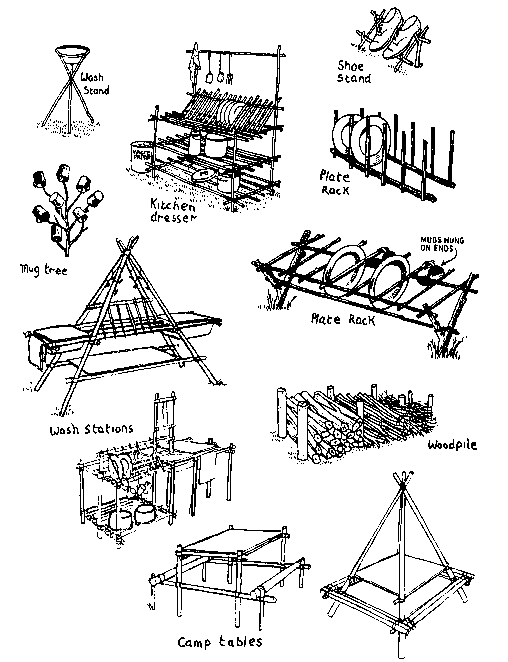 |
| Camp gadgets |
• Camp gateways
 |
| Camp gateways |
• Catapults
 |
| Catapults |
• Chairs
 |
| Chairs |
• Chippewa Kitchens
 |
| Chippewa Kitchens |
• Dressers
• Ferris Wheel
• Flagpoles
• Merry-Go-Rounds
• Rafts
• See Saws
• Swing Sets
• Swinging Ships
• Tables
• Towers
• Trebuchets
• Flagpoles
• Merry-Go-Rounds
• Rafts
• See Saws
• Swing Sets
• Swinging Ships
• Tables
• Towers
• Trebuchets
Subscribe to:
Posts (Atom)